Does a grudge change how we read a coworker's messages, even when the words are neutral?
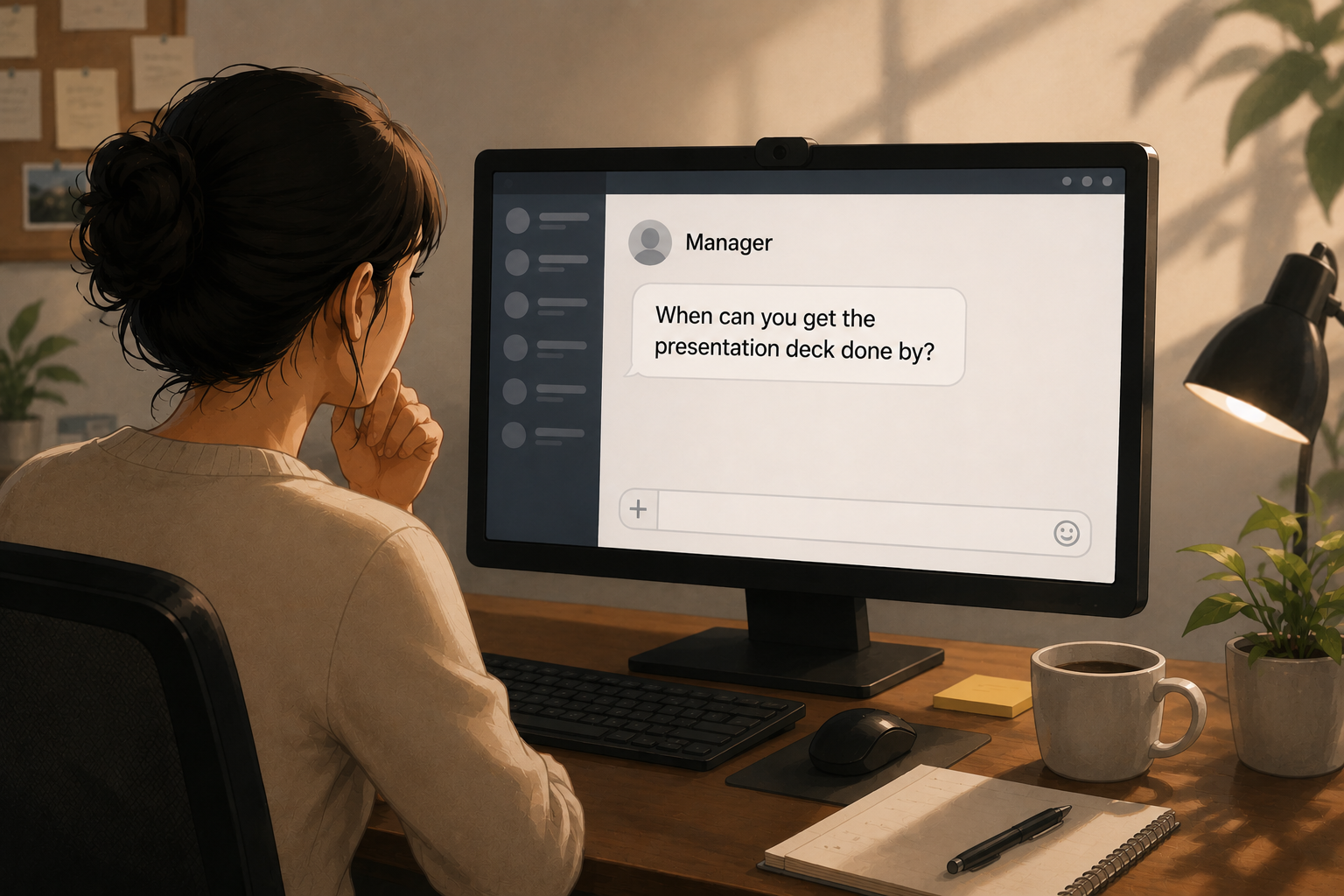
A colleague once showed me a message from her manager: "When can you get the presentation deck done by?" She read impatience. I read a plain question about timing.
I kept noticing the pattern: neutral messages read through the lens of old frustration. And because instant messaging strips away tone and cues, short messages are wide open to it. No study had tested this directly, so I designed an experiment to find out.
Three questions: does a grudge bias the reading, what drives it, and does it compound?
People holding a grudge read ambiguous messages more negatively than those who resolved a grudge, or feel neutral.
Is that negativity driven by rumination, the act of stewing on the coworker?
Does a negative reading then feed more rumination, becoming self-reinforcing?
Everyone rated the same ten messages. Only the relationship behind them changed.
I ran this as an online experiment inside a Qualtrics survey. 329 UK employees, recruited via Prolific, were randomly split into three groups, and every group then completed the same session.
From there, every participant followed the same 15-minute survey, moving through six steps in order.
Baseline
Emotion and trait rumination measured before any conflict recall, so the starting point wasn't coloured by memories.
Induction
A five-minute writing task about the assigned coworker evoked the intended emotional state.
Rumination T1
A timed one-minute pause, then participants reported the share of time spent thinking negatively. The pause captured rumination indirectly, without asking for it head-on.
Tone task
Participants rated the ten ambiguous messages, each shown as if sent by the recalled coworker, on a 7-point scale (1 - very negative, 4 - neutral, 7 - very positive).
Rumination T2
A second pause and the same measure, to test whether the negative reading fed later rumination.
Debrief
Demographics, then a positive-affect video so no one left the study in a negative state.
The ten messages rated in the tone task (step 4)
- "Do you have a minute?"
- "Let's discuss this after the meeting."
- "I don't understand what you mean. Please clarify."
- "Has this been reviewed?"
- "Don't forget we have a meeting later at 3 pm."
- "When was the decision to go ahead made?"
- "Has this task been completed?"
- "I will need this done by tomorrow."
- "Is this file the latest version?"
- "Let me handle this task."
Rated one at a time on a 7-point scale (very negative to very positive), each shown as if sent by the recalled coworker.
Power analysis, randomisation and manipulation checks, ANOVA, regression, and mediation, run in Stata
Each stage below shows its purpose and its key statistical result.
A grudge made short, neutral text read as negative. And "resolved" didn't fully reset it.
There are differences in perceived IM tone across the three conditions. Participants rated each message from 1 to 7 (very negative to very positive), with 4 being neutral. The same neutral message came across as more negative to someone carrying a grudge than to someone who felt neutral (about 2.9 versus 4.1). And the relationship the participants had in mind explained 27% of the differences in how people read the messages. All three groups differed from one another, and the pattern held up across every test I ran (ANOVA, pairwise comparisons & regression), making it very unlikely to be a chance result.
The surprise: the resolved group still read messages more negatively than neutral (difference 0.75, 95% CI [0.48, 1.02]). Subjective resolution left a residue.
Grudge-holders ruminated more, but rumination didn't predict their negative readings. The judgement looked fast and automatic, an on-guard response. It did partially mediate for the resolved group, where the delay appears to have reactivated dormant memories.
A more negative overall reading predicted higher rumination minutes later (β=−2.53, p=.01), after controlling for prior rumination. The effect is small, a one-unit shift toward a more negative reading adds about 2.5 percentage points to the time spent dwelling, but it points to a loop: reading the messages more negatively feeds the rumination that keeps a strained relationship strained.
The bias starts before a word is read, and it accumulates unnoticed.
A grudge tilts an ordinary message toward a negative reading, and even a grudge believed resolved can tilt it too. Clarifying tone over IM feels awkward, so people absorb the negative read and move on. Over hundreds of messages, that is how minor friction hardens into lasting tension, eroding cooperation, wellbeing, and performance.
Two levers follow: early conflict resolution, because subjective resolution doesn't fully reset perception, and psychological safety, because the fix depends on people feeling able to check intent before assumptions calcify.
Even a grudge believed to be resolved can quietly tilt how we read the next message.